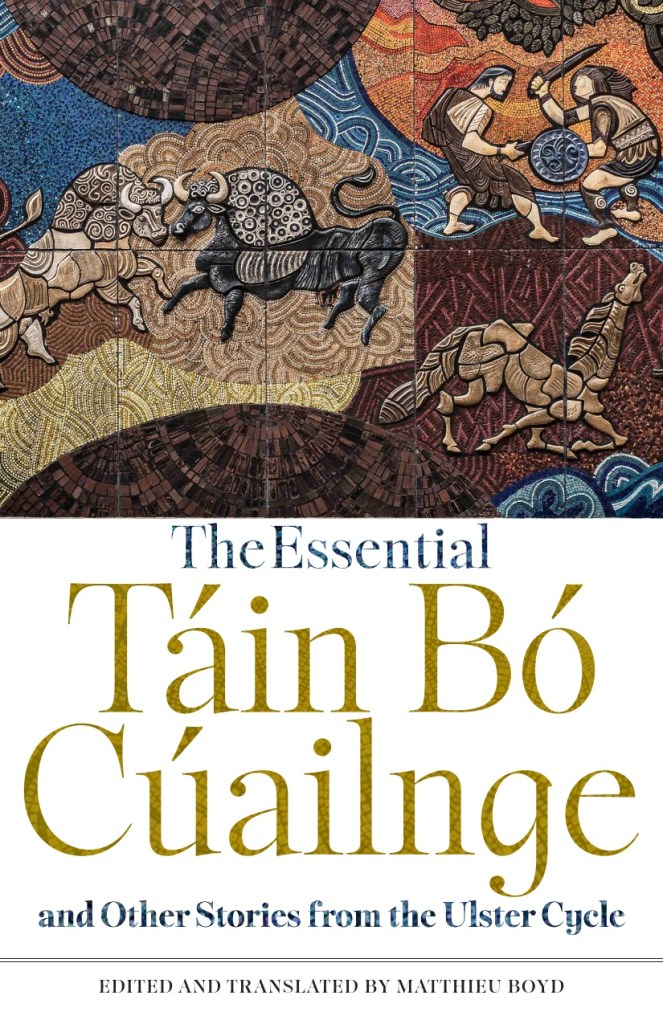
The Essential Táin Bó Cúailnge and Other Stories from the Ulster Cycle (2025)
Táin Bó Cúailnge or “The Cattle-Raid of Cooley”—”the Táin,” for short—is the national epic of Ireland, echoing through the literary tradition for over a thousand years. It is set in a heroic age supposedly around the time of Christ. Early in November, Queen Maeve (Medb) and her husband King Ailill of the western province of Connacht lead a massive invasion of the northern province of Ulster to capture the extraordinary Brown Bull of the Cúailnge peninsula. The path they take is so precise you can use it to plan your next trip across Ireland. For magical reasons, the Ulstermen are helpless for most of the invasion, except for an army of exiles that fights for Maeve. Almost alone against this horde of 54,000 is one man, the supernaturally gifted 16-year-old hero Cú Chulainn. Spectacular violence, grisly humor, and heartbreak ensue.
The Táin has been translated many times before (though not as often as Beowulf or Homer’s Iliad), but mine is the first English translation in almost two decades. The best options in English for the last 60 years have otherwise been Cecile O’Rahilly’s critical editions of the Irish texts with facing-page translation (1967 for the Book of Leinster version and 1976 for Recension 1) and iconic versions by the poets Thomas Kinsella (1969) and Ciaran Carson (2007). Without taking anything away from those—O’Rahilly is the “gold standard” for scholarly purposes and I taught with Kinsella for many years—my translation tries to make a new contribution in these specific ways:
- a more approachable and even colloquial style, particularly aimed at university students and non-academic readers in North America, that maintains enough accuracy to support close reading. I don’t try to write in Hiberno-English, or go for poetic elegance at the expense of what the texts are literally saying. I wouldn’t have been able to go through with my translation if my students in New Jersey hadn’t told me clearly that my version added to their understanding and enjoyment.
- in keeping with the richly intertexual nature of the early Irish sagas, more prequels and sequels to accompany the Táin than ever before available in one package. (Kinsella has some of the prequels but none of the sequels; Carson has only the Táin and tries to make up for it with endnotes.) The Táin is the centerpiece of many separate tales collectively known as the Ulster Cycle, and these give us crucial backstory on many of the characters and tell us what happens to them in the end. Some of these stories have the potential to transform our reading of the Táin itself, for example the one (not in Kinsella) that shows us Queen Maeve as a survivor of sexual violence by the Ulster king Conchobor, giving her more levels of motivation in going after the bull.
- judicious abridgments (always clearly signposted) to cut down on repetitive scenes of bloodshed and trivia. To be clear about these: O’Rahilly’s translations of the entire Táin in both of the main recensions are available in full, for free, online. I wasn’t going to pretend they weren’t, and cutting back on Cú Chulainn killing yet another dozen opponents gave me room for more of the ancillary tales. Meanwhile, nothing—from rape to abortion to incest to graphic dismemberment—was abridged for reasons of prudishness (unless the original text was being prudish), and I didn’t shy away from translating “Don’t fuck with me” when the Irish seemed to be saying exactly that.
- corrections, insights, and background information—over 30,000 words of footnotes and other aids—drawing on the last 50+ years of specialist research. Early Irish is genuinely difficult and our knowledge of it is constantly improving: even O’Rahilly and other great scholars of the past weren’t always sure what the texts were saying, and entire articles have been published on one or another of the embedded poems. Detailed trees help you visualize the relationships among dozens of characters. Archaeological research has also led to more accurate maps than ever before, in this case by distinguished archaeologist Paul Gosling.
So far the book has been reviewed by Albrecht Classen in Mediaevistik.
Order here. (If you want an ebook, consider Google Play over Amazon Kindle because of all the footnotes.)
Whatever you think of my artistic choices, from a scholarly perspective I am committed to getting it right, or at least as right as I possibly can. You can download corrections and updates to the book here (last updated 15 September 2026).
 Matthieu Boyd